


Tonk Star Classic Card Game
Garia Games Ltd
Tonk Star Classic Card Game is the kind of mobile card game I open when I want a familiar ruleset without committing to a long, complicated session. It focuses on classic Tonk rather than dressing the experience up with unrelated modes, so the appeal comes from making quick decisions with a small hand, watching the discard pile, and judging when to end a round. My overall view is positive: it is a focused choice for Tonk players, although people looking for a broad collection of card games or a deeply social experience may find its narrow purpose limiting.
Developed by Garia Games Ltd, this free card game has built a solid audience, with over five thousand ratings and an average score of 4.6. That response makes sense once the central idea becomes clear: the game tries to preserve the traditional feel of Tonk in a format that is easy to pick up on a phone. It is rated Teen, runs on Android 7.0 and later, and the current release is version 3.9.9.409. Those details make it accessible to many older devices, though the age rating is worth checking for younger players before installing.
Why the classic Tonk format works well on a phone
The strongest part of this game is its commitment to the core card experience. Tonk rewards attention more than fast tapping. I need to remember what has already been discarded, notice which cards might help an opponent, and decide whether holding a promising card is worth the risk. Because the hand is compact and turns are easy to understand, a round can fit naturally into a short break, a commute, or a quiet few minutes before bed.
That simplicity does not mean the decisions are shallow. A low card can be valuable because it reduces the hand total, while a higher card may be worth keeping if it helps form a useful combination. The difficult choice is often not identifying a good play, but deciding when not to chase a better one. I particularly like that tension because it gives each turn a purpose: draw for information, discard to reduce danger, or hold back because the visible cards suggest a better opportunity may appear.
The original-rules focus is also useful for players who already know Tonk from physical cards. I do not have to learn a new scoring philosophy or adjust to a completely redesigned version of the game. That makes it a convenient substitute when nobody nearby is available for a tabletop round. It also makes the app easier to recommend to a friend who wants to practice the basics before playing with people in person.
Related News






One practical tip is to treat the discard pile as information rather than merely a source of unwanted cards. If I repeatedly throw away cards that could complete a combination, I may be giving an opponent exactly what they need. At the same time, refusing every useful-looking discard can leave my own hand too heavy. Tonk Star is most enjoyable when I use the visible history of the round to make a measured decision instead of playing each turn in isolation.
Another useful habit is to set a personal stopping point before a round becomes frustrating. Since the game is free to install, it is tempting to continue immediately after an unlucky result. I find the experience better when I treat each hand as a separate puzzle rather than trying to recover a losing streak. That approach also highlights the game’s real strength: it is at its best as a compact thinking game, not as a background activity played without attention.
A good fit for short, focused sessions
For an everyday example, imagine having ten minutes while waiting for an appointment. A large strategy game may take too long to load or demand sustained concentration across several systems. This game is more suitable because the rules are recognizable and the action is divided into manageable turns. I can play a round, put the phone away, and return later without needing to remember a complicated campaign or inventory.
Gallery
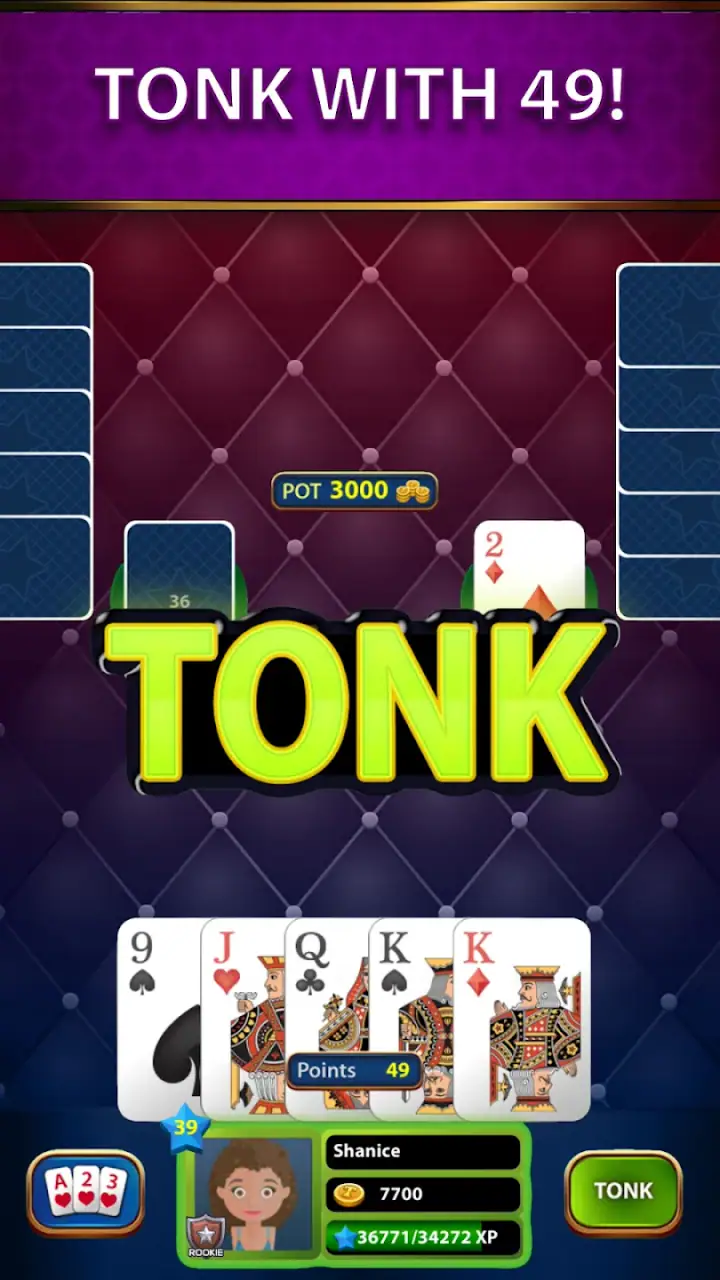
It can also work well for someone who enjoys traditional cards but wants a private way to sharpen decision-making. I would not describe it as a replacement for sitting around a table with friends, because the social atmosphere is different. Still, it offers a useful solo-style alternative when a physical deck is unavailable. The value comes from repetition: after several rounds, I become more aware of when I am holding cards for a real reason and when I am simply hoping for luck.
The game’s audience size supports that practical appeal. It has passed one hundred thousand installs, which suggests it is not an obscure experiment with no established player interest. I would still judge it by its focused design rather than by popularity alone. A large install count cannot make a narrow card game suitable for everyone, but it does make the app easier to consider as a known option for people specifically searching for Tonk.
Where the experience may feel restrictive
The same focus that makes Tonk Star approachable can also become its main weakness. This is a Tonk game first, not a broad card-game collection. If I want poker, rummy, solitaire, or a rotating selection of unrelated table games, I would be better served by an app designed around variety. Installing this one expecting a complete card hub would lead to disappointment because its identity depends on staying with one traditional format.
There is also a natural learning curve for anyone unfamiliar with Tonk. The rules may look straightforward, but the best choices depend on timing, hand value, and reading the discard sequence. A new player can understand the basic action while still making poor decisions for several rounds. I think that is acceptable for a strategy card game, but it means the app is not ideal for someone who wants instant, consequence-free entertainment with no need to remember what happened earlier.
Another limitation is the presence of optional in-app purchases, which range from $0.99 to $79.99 per item. The game itself is free, so I can try the central experience without paying upfront. However, anyone who prefers a completely purchase-free environment should review the payment choices carefully and avoid treating optional spending as part of the normal cost of playing. I consider the free entry a strength, but the wide purchase range is still something budget-conscious users should keep in mind.
The Teen rating is another reason I would not install it automatically on a child’s device. That rating is not a criticism of the card mechanics; it is simply a reminder that the intended audience is older than young children. Parents should make their own decision based on the device, the player’s age, and how they want purchases handled. For adult card fans, the rating is unlikely to be a concern, but it should not be ignored when recommending the game to a family.
How it compares with physical cards and broader alternatives
Compared with a physical deck, the main advantage is convenience. The app removes setup, shuffling, and the need to find another player at the same moment. It is ready when I have a spare pocket of time. The trade-off is that a phone cannot reproduce the conversation, table presence, or friendly negotiation that makes a real card night memorable. I see it as a practical companion to physical Tonk, not a full replacement for it.
Compared with general card-game apps, its advantage is clarity of purpose. A large collection can offer more variety, but it may also bury the game I actually want beneath menus, modes, and unrelated systems. Tonk Star makes more sense when I already know I want Tonk and would rather spend my time playing than browsing. The broader alternative wins for households with mixed tastes; this app wins for a player who wants one particular traditional game close at hand.
Compared with casual puzzle games, it demands more memory and risk assessment. I cannot rely only on quick reactions or random rewards. That makes it a better choice for someone who enjoys deliberate turns, but a weaker choice for a player seeking visual spectacle or constant novelty. Its entertainment comes from improving judgment, not from unlocking a large world or collecting elaborate content.
Who should install it, and who should skip it
I would recommend it to players who already enjoy Tonk, people learning the game for the first time, and card fans who appreciate short rounds with meaningful decisions. It is especially suitable for someone who wants a free starting point before deciding whether a mobile Tonk game deserves regular play. The older Android requirement is modest enough to include many devices, so compatibility should not be a major obstacle for users on relatively recent phones.
I would also suggest it to anyone who likes analyzing probability without needing a complex strategy interface. The best way to enjoy it is to play actively: remember discarded cards, avoid feeding useful cards to an opponent, and recognize when a safe hand is preferable to an ambitious one. Those small habits turn the game from simple tapping into a more satisfying exercise in restraint.
I would skip it if my priority were a large multiplayer social space, a campaign, frequent genre changes, or a visually elaborate presentation. I would also hesitate if I disliked card games where luck can affect the result even when the decisions are sensible. Good play improves the odds, but it does not remove uncertainty. Players who want total control over every outcome may find the format irritating rather than relaxing.
Before installing, I would ask myself three practical questions. Do I specifically want Tonk rather than a general card collection? Am I comfortable with a free game that offers optional purchases? And do I enjoy remembering earlier cards instead of playing every turn casually? If the answer to all three is yes, the app has a clear reason to be on my phone. If the answer is no, another card game will probably offer a better match.
My final verdict on the mobile Tonk experience
My verdict is that Tonk Star Classic Card Game succeeds because it understands its audience. It does not need to reinvent Tonk to be useful; it needs to make the traditional rules convenient, readable, and easy to revisit. The strong rating from thousands of players and the broad install base reinforce that it has found a receptive audience, while the free entry makes trying it straightforward.
The important qualification is that its value depends almost entirely on whether I want Tonk. For the right player, the narrow focus is a benefit: I get a familiar card game that fits into short sessions and rewards careful choices. For someone seeking variety, social depth, or a completely purchase-free experience, the same design becomes a limitation.
I recommend it as a focused Tonk companion rather than an all-purpose card app. Give it a try if you enjoy traditional card decisions, want a convenient way to play on Android, and are willing to learn from a few rough rounds. I would keep my expectations centered on thoughtful hands and repeat play, not on a huge range of modes. Within that boundary, Garia Games Ltd has delivered a sensible, approachable option for players who want classic Tonk available whenever a deck and a table are not.
FAQs for Tonk Star Classic Card Game
What is Tonk Star Classic Card Game?
Tonk Star Classic Card Game is a digital version of the traditional Tonk, or Tunk, card game. It is generally played with a standard deck and focuses on drawing, discarding, and forming combinations while trying to reduce the value of cards left in your hand. The app is designed for quick rounds and casual card-game sessions on a mobile device.
How do you play Tonk Star Classic Card Game?
The basic objective is to arrange your cards into groups or sequences and finish with the lowest possible hand value. During each turn, you usually draw a card from the deck or discard pile and then discard one card. Depending on the rules used in the game, players may also be able to knock or declare Tonk when they believe their hand is strong enough.
Can Tonk Star Classic Card Game be played offline?
Offline availability can depend on the specific version of Tonk Star installed and the feature being used. Some single-player modes may work without a constant internet connection, while online competitions, advertisements, leaderboards, rewards, or account-related features may require access to the internet. It is best to check the app description and test the desired mode after installation.
Is Tonk Star Classic Card Game free to download?
Tonk Star Classic Card Game may be available as a free download, but free access does not always mean that every feature is completely cost-free. Mobile card games commonly include advertising, optional in-app purchases, virtual currency, or paid benefits. Before downloading, review the store listing for current pricing information and check whether purchases can be restricted through your device settings.
Is Tonk Star Classic Card Game suitable for beginners?
The game can be suitable for beginners, especially if its tutorial, practice mode, or guided instructions explain the card combinations and scoring system clearly. However, Tonk rules can vary between versions, so new players should read the in-game instructions before starting competitive rounds. Beginners may also benefit from playing several low-pressure games to learn when to draw, discard, or declare.
Pros
- Simple rules make it easy for new players to start quickly.
- Short rounds fit well into brief gaming sessions.
- Classic card-game format offers familiar
- relaxing entertainment.
- Clean interface keeps the focus on the cards and gameplay.
- Playable without intense concentration or complicated strategy.
Cons
- Limited variety may make the experience feel repetitive over time.
- Luck can strongly influence results
- reducing the impact of strategy.
- Ads may interrupt play
- depending on the version and settings.
- Mostly single-gameplay content offers little beyond traditional Tonk.
- Players may miss advanced options or deeper customization features.


